
Straight Talk (1992) Shows That Every Chicago Movie is a Love Letter to the City

Guest post alert! Today’s newsletter is another gem from my regular early September guest writer and dear friend Nellie Beckett, who has treated us to post-Labor Day insights about Mary Poppins and Big Business in previous years (as well as a rather popular piece about Muriel’s Wedding last March). If you want to read and/or hear more from Nellie after reading this entry (and I bet you will), give her newsletter Kulturtante a read, and then follow her reporting for Gulf States Newsroom, where she’s digging up the real stories about the Third Coast. (No, not Chicago, the other actual third coast. You know, the one our President cares way too much about.) Take it away, Nellie!
I remarked recently that there was no place scarier in the 80s than the movie version of New York City. But on the flip side, there was no place dreamier than the Windy City during that era.1 Even when it’s supposed to be scary, like in Adventures in Babysitting, celluloid Chicago is a Hughes-tinted idyll of tall buildings, clear skies, and blues riffs.
Like Straight Talk, I arrived in sunny Chicago in April of 1992. The river was still green from the St. Patrick’s Day parade. Chicago English became my first language. I remember snapshots of my early childhood there: the spackled grey bricks that seem to make up every residential building, the crunch of aluminum cans underfoot, the smell of smoked meat in butcher shops and burnt cacao from the Blommer Chocolate Factory, downtown men in paisley ties, and the ubiquity of cow-themed modern art. Seeing movies from 80s and 90s Chicago is like a pleasant, happy dream for me that blurs cinema with real-life memories.
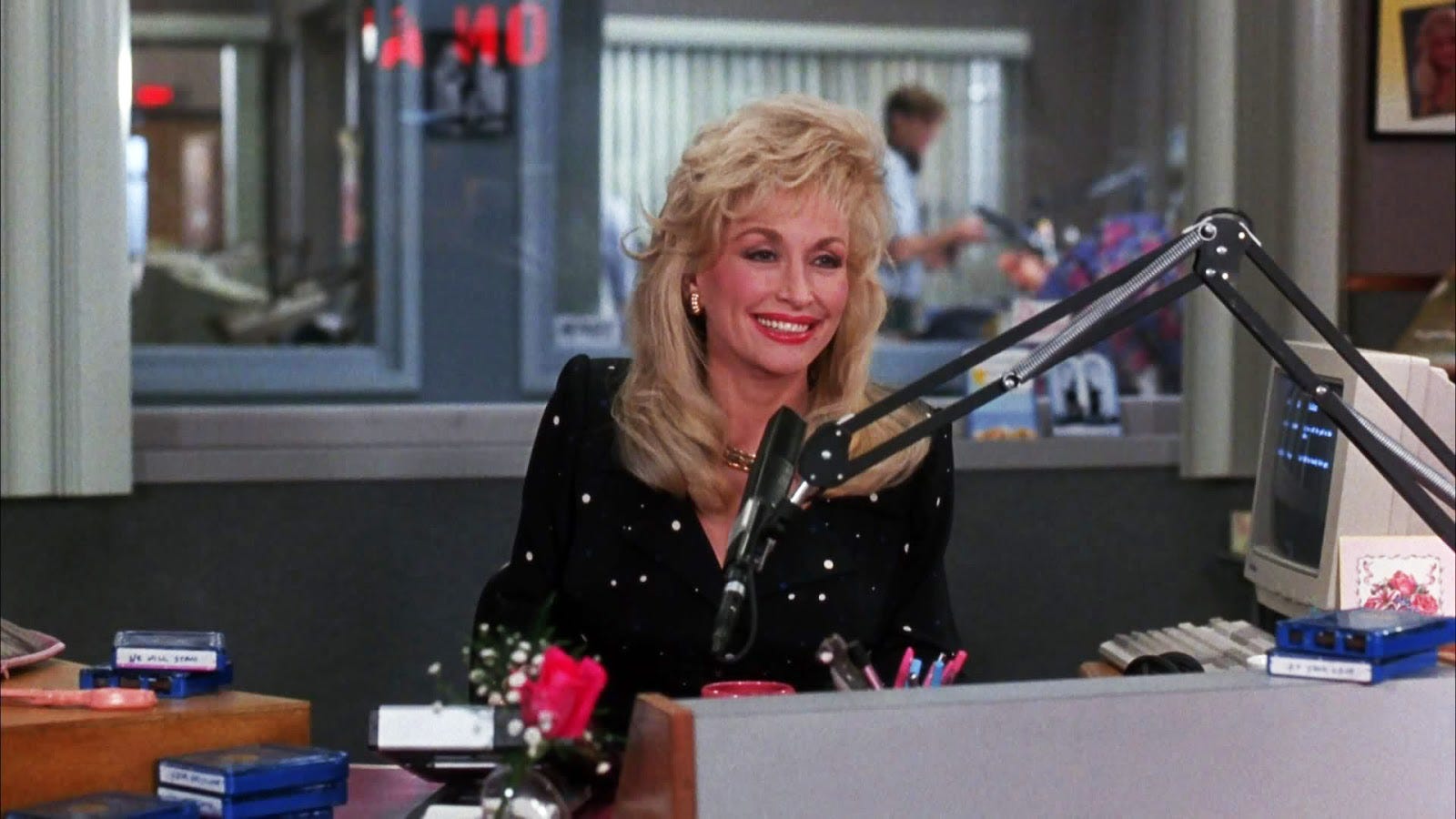
Straight Talk might be the best example of Chicago flaunting itself, with the plot and actors (except for the luminous Dolly Parton) being totally secondary to the Second City. Parton plays Shirlee Kenyon, an Arkansas dance instructor who dumps meathead Michael Madsen for a life in the big city. When Shirlee is mistaken for Dr. Kendall, a sort of Dr. Laura meets Delilah type, the producers of a local radio station throw her on the air, and she charms Chicago listeners with her folksy yet direct advice. Dolly basically plays the same angelic good ol’ gal in every movie, but it’s fine—we love her tinkling laugh and country aphorisms and no-bullshit tough love talk show.
An underrated point of accuracy in this movie: the directness that is the love language of the City of Big Shoulders. The Midwest is not a monolith.2 Minnesota, for example, is all about indirectness (see, the entire Coen oeuvre), but Chicago shoots straight. Chicago is also a radio town to the core. On every trip back, I’m struck by the ubiquity of WBEZ merch, WXRT blasting through open windows, NPR lampooned in Second City skits, live tapings of podcasts, and station marketing at seemingly every bus stop. The radio is a soundtrack to city life, and I’m hard pressed to name another movie that dramatizes the medium better.
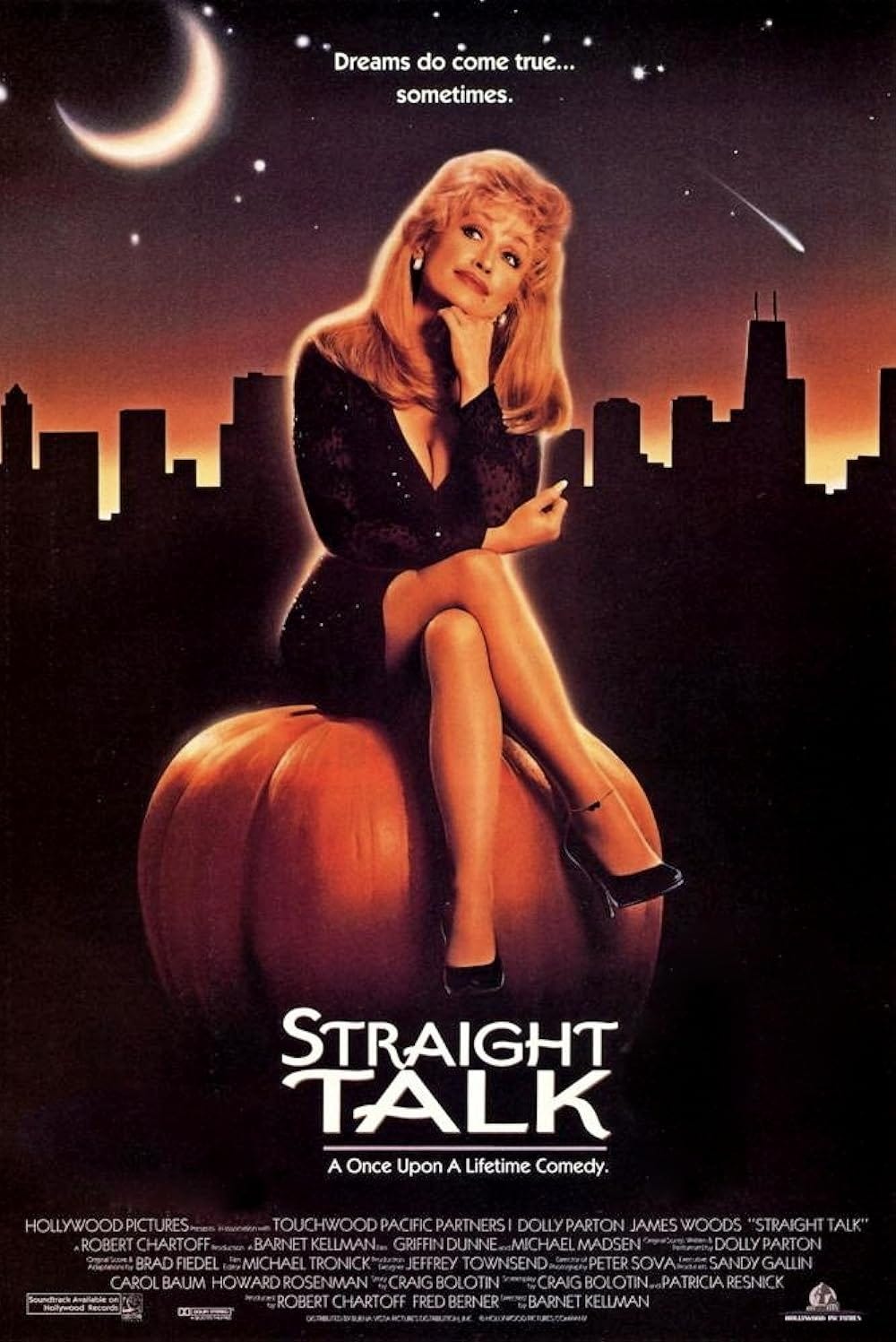
Between the radio advice scenes, watching Straight Talk is basically like watching a kid play Dolly Parton powersuit paper dolls in a city-scale Barbie dream house. She goes on a shopping spree at Marshall Fields, she dances onstage at the Rainbo Club, she almost falls off the Wabash Avenue Bridge, she drinks champagne at a swanky gala at the Field Museum. Hop hop hop, here she tours a Frasurbane condo! Hop hop, now she’s in a limo!
In this Radio Barbie tableau, heavy hitter actors randomly appear. Spalding Grey! Griffin Dunne! The great Tracy Letts, a titan of Chicago theatre! John fucking Sayles! There’s also a roll call of actors who got their start in the Chicago theatre trenches: Paul Dinello, Jane Lynch, Amy Morton. There’s even a flimsy love plot with a journalist played by James Woods. This really is a movie about obsolete media!3 In true Chicago fashion, I could definitely see it adapted as a stage play.
Straight Talk rides the power suit coattails of Working Girl proto-girlboss years. As does Big Business, another fantastic movie about sassy Southern women in the big city. But as you know if you were there, the 80s dragged on into the first couple years of the 90s. A few miles over from Shirlee’s downtown office, Billy Corgan and Jeff Tweedy and Liz Phair (another sultry blonde with straight talk about relationships) were changing indie rock on a seismic level and defining the 90s as we know them. But you wouldn’t know it from Straight Talk’s stodgy world of powdered creamer and fax machines.
The Windy City would go on to capture the zeitgeist not just with music but with the Bulls, Oprah, and the Onion, to name a few era-defining exports. The Chicago decade of cultural dominance and change is bookended by High Fidelity, another love letter to analog media and relationships and the city, albeit more of a Dear John. I cringed during a rewatch of High Fidelity, but just like with Straight Talk, I sank into the lush world of Chicago on location. And in both cases, the background and soundtrack were almost more interesting than the people within them.
When I stumbled into a community engagement/radio career a year ago, I thought of Straight Talk. I’m not the only woman with an accidental media path inspired by it either—erstwhile L.A. party girl blogger Dear Coquette (née Coketalk) also tipped her hat with her icon image. And it’s had a lasting influence on the city as well. On a recent trip to Chicago, I was stunned by hip boutiques strung with banners that said “All Y’all Are Welcome But You Gotta Act Right”— it seemed like a little Dolly-style pixie dust that wouldn’t have been out of place in the world of Straight Talk. Moonshine and Malört, anyone?
Straight Talk is now streaming on Hoopla, and it’s available to rent elsewhere.
Sorry, L.A.
Neither is the South, but that’s another discussion for another newsletter about regional stereotypes on film.
Straight Talk went to VHS fairly quickly, according to Wikipedia, though it did make more than $20 million at the box office.
 | A guest post by
|
Forgot to mention this in my intro but this piece had me dying to visit Chicago again...and I was just there in June. Go Bulls.