
Saving Silverman (2001) is Neil Diamond’s Attempt at a Cinematic Redemption

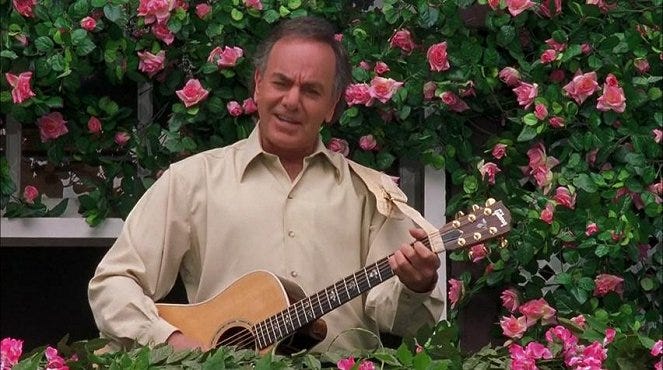
Happy Valentine’s Day Eve, readers! And many thanks to all of you who came through last night for the first Tape Night of the year at the Sidewalk Cinema! We had some VCR malfunctions, but thankfully Nick the projectionist is quick on his feet and he was able to pull up a free stream of Saving Silverman in standard definition from a Russian server, which is probably the next best thing to a videotape. It’s hard to believe this film is 25 years old now, and I’m pleased to report it still has the power to make people laugh. Speaking of Sidewalk, though, let’s jump right in to this week’s lengthy intro…
Last month, my friends at the Sidewalk Cinema held their annual Bad Movie Marathon fundraiser. More than a dozen “marathoners” spent a weekend in the theater watching one “bad” movie after another, and people donated money to give them perks like meals, caffeinated beverages, brief naps—and veto privileges if they wish to skip a title that they simply cannot abide.1
After sitting through nearly 24 hours of stinkers like Mac and Me, Chairman of the Board, and Stalked By My Doctor: The Return, the bad movie wheel landed on the 1980 version of The Jazz Singer. It was immediately vetoed “for reasons obvious to anyone who has seen the movie,” as my friend Chance wrote in his Instagram post.
The film has a complicated legacy, if we’re being generous. The fourth screen adaptation of a 1925 play, it was a modest success, nearly doubling its budget at the box office. And the soundtrack went on to sell more than five million copies, making it Diamond’s most successful album by far. But reviews at the time weren’t very positive, many of them picking on Diamond’s performance in particular.2 And the film’s reputation has (rightfully) been all but obliterated because of a scene that not only features blackface but treats it as light-hearted comedy.3
The Jazz Singer was Neil Diamond’s acting debut. He never acted again. Or, more accurately, he never played a character on screen again.
Because an opportunity at the dawn of the new century came along and offered to wipe his cinematic slate clean. An opportunity anchored by the guy who had sex with an apple pie in his big-screen breakthrough role.
Saving Silverman was director Dennis Dugan’s follow-up to Big Daddy, which made nearly a quarter-billion dollars worldwide and made Adam Sandler an even bigger star. He had more of a challenge on his hands this time, attempting to vault American Pie star Jason Biggs into a similar stratosphere after a pair of box-office bombs in Loser and Boys and Girls. As it turns out, Biggs’ acting capabilities are relatively limited, and the film grossed a mere $26 million against a $22 million budget.4
Biggs’ co-stars Jack Black and Steve Zahn have gone on to have excellent careers, but they were still young and relatively unproven at the time. And Amanda Peet—who does great work in an underwritten role here—had only broken through in The Whole Nine Yards a year earlier. On paper, the project was far from a safe financial bet.
I can’t imagine Neil Diamond knew who any of these people were when the script landed in his agent’s hands. He might’ve seen Peet in her episode of Seinfeld. Perhaps one of his children talked him into watching High Fidelity.5 But I’m betting he had little interest in modern movies after his seemingly unpleasant experience with The Jazz Singer.
So what compelled him to return to the big screen—as himself, no less—in a juvenile romcom aimed at teenagers?
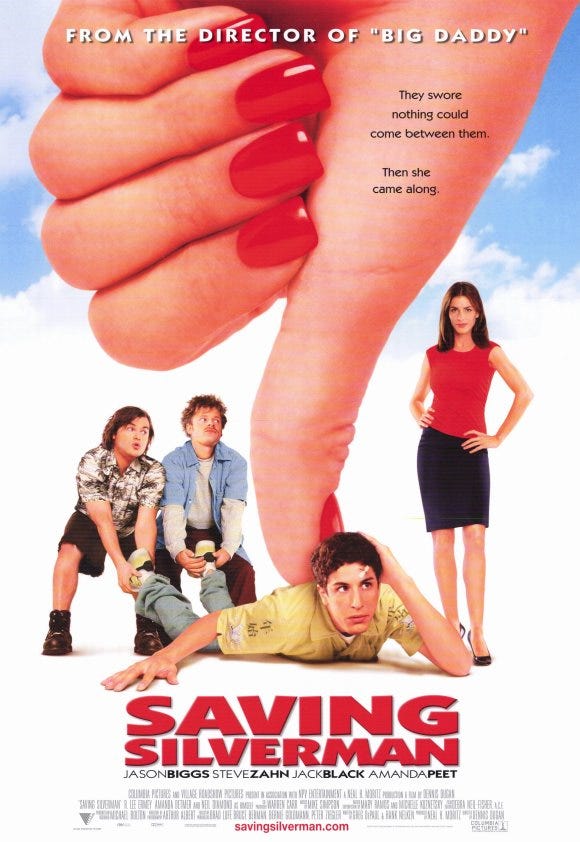
Maybe he was bored. Maybe he was broke. But I like to think it was the sincerity of the screenplay and the way it portrays his celebrity status. Neil Diamond isn’t a punchline in Saving Silverman; in fact, he gets to deliver a couple of comedic lines himself.6 It’s true that two of the four Diamond-obsessed characters in the film are idiots—that would be Silverman’s two best friends, J.D. (Black) and Wayne (Zahn), with whom he plays in a tribute band called Diamonds in the Rough. But the other two are Darren Silverman himself (Biggs) and his “one that got away,” Sandy Perkus (played by the lovely Amanda Detmer), and it’s their love of Neil’s catalog that brings them together years after meeting in high school.
Diamond joked that he was “dragged into this project kicking and screaming.” And maybe he really was hesitant at first. But he bought all the way in.
After a brief appearance in an early flashback, Neil shows up at the film’s climax, when J.D., Wayne, and Sandy kidnap him from a concert in hopes that he’ll help them “save” their friend from a nightmare marriage. At first, Neil is unenthused, but after hearing a little more about their plight, he has an epiphany: “I’ve spent my life writing songs about the power of love. But up until now, they’ve only been words. This may be my chance to prove that those words really mean something. …I believe in happy endings. If Neil Diamond has anything to do with it…this love story will have one.”
It’s a pretty silly mini-monologue, but I wonder if he read those lines on the page and believed them just a little bit. Just enough to say yes to a goofy crime comedy where he’s upheld as “America’s greatest songwriter.”
There’s more of a redemption angle to it than one might think, though. Diamonds in the Rough play “Cherry Cherry” both times we see them, and “Holly Holy” is the song being performed over the closing credits. But it’s the soundtrack for The Jazz Singer, Neil’s failed attempt at multi-talent stardom, that serves as the core musical text of Saving Silverman. “America” plays as Diamond and the gang speed across town to crash Darren’s wedding. “Hello Again” is the song that Darren and Sandy sing to each other on their first date and the song that Neil serenades them with to convince Darren to choose the right girl. Neil even references “Love On The Rocks” in a bit of funny throwaway dialogue when he first meets his new friends.
But it wasn’t just a redemption story for Neil Diamond. It was a chance to create something new. A new song, in fact: “I Believe in Happy Endings,” which he wrote for the film. And years later, he revealed that he actually wrote a second song for the soundtrack called “The Ballad of Saving Silverman,” which sums up the plot of the film. Diamond didn’t send Dugan the song until after the film had already been released, but he was proud enough of it to shelve it for nearly two decades. He finally released it in 2018 among 114 other tracks for The Neil Diamond 50th Anniversary Collector’s Edition box set. It’s not his best work, but it’s charming—much like the film he wrote it for.
Neil Diamond believes in happy endings. And after the fiasco that was The Jazz Singer, I’m glad he got one of his own with Saving Silverman.
Saving Silverman is now streaming on YouTube, and it is available to rent elsewhere.
Before you ask, yes, I have indeed “run” in the Bad Movie Marathon before. Twice, in fact. And I lasted about 24 hours each time. But I am a tired lad with sleep apnea who probably shouldn’t be doing things like that anymore. I applaud this year’s marathoners for raising more than $30,000 though!
Roger Ebert didn’t hold back in his review, noting that the film “has so many things wrong with it that a review threatens to become a list.”
Gene Siskel was kinder to the film than his colleague, but he pointed out that its major issue was “a script that forces [Diamond] to do some very foolish things.” That’s one way of putting it, Gene!
I can’t believe this film cost $22 million. I hope half of that went to Neil Diamond.
Now I’m imagining Neil Diamond watching the Tenacious D TV series and I’m really enjoying this vision.
My personal favorite is when he excitedly says “Hey, we’re coming to America” as he and the gang approach America Ave. That’s pure gold, my friends.
I feel like I was built specifically to endure a Bad Movie Marathon.
Loser is a misunderstood masterpiece.