
We Need to Bring Back Bittersweet Christmas Movies Like Prancer (1989)

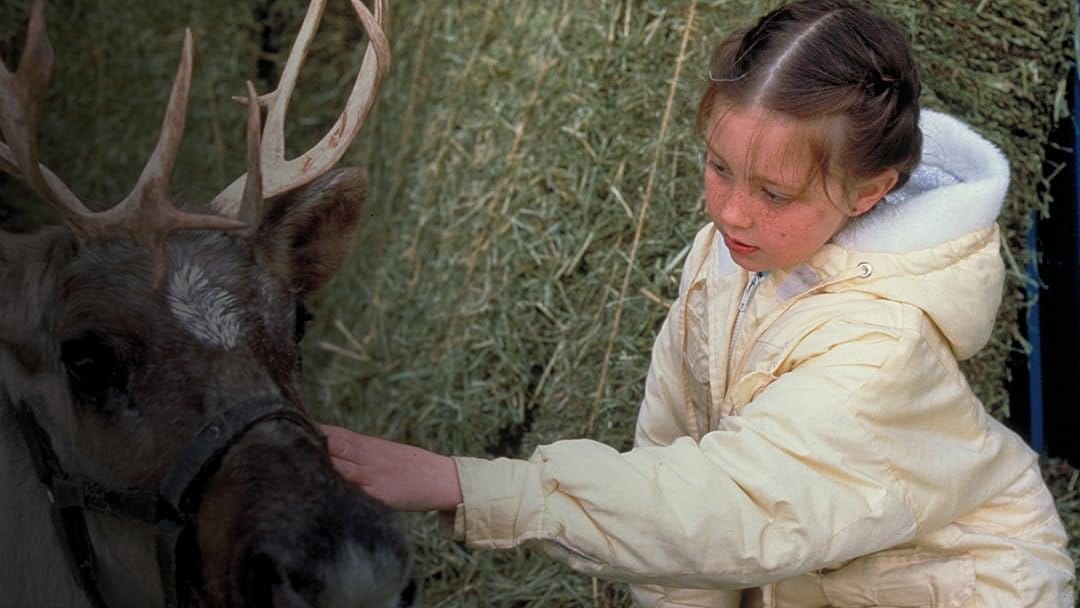
Happy Boxing Day, reader! I hope you’ll permit my publishing this newsletter about a Christmas movie a day late. I originally wanted to run this piece last Friday, but I couldn’t not write about Rob Reiner, so this one got punted. (Since you asked, we’ll be doing the annual pre-New Year’s round up two days after New Year’s Eve. It’s the only way.) Also, if you’ve never seen Prancer, I basically spoil the entire plot here, so you’ve been warned. I hope you’re all enjoying a nice holiday break and you get to pet a reindeer sometime soon.
We haven’t yet found any tangible proof of it yet (though not for lack of trying), but I’ve been told all my life that my mother’s side of the family traces back in some fashion to the famed poet Henry Wadsworth Longfellow. If you’ve ever studied poetry, you probably know Evangeline, Paul Revere’s Ride, or The Song of Hiawatha.1
But I reckon his most well-known work is Christmas Bells, his poem that we now know in carol form as I Heard the Bells on Christmas Day. I don’t know that it’s my favorite Longfellow poem, but it’s the one I think about the most, even outside of the holiday season. Because, if you’ll pardon my pun, it still rings true today. Perhaps louder than ever in my own ears.
It’s a lovely poem, and it ends on a positive note, but it takes a pretty bleak path to get there. Three of the seven stanzas are filled with despair. Longfellow wrote Christmas Bells in the wake of both nationwide devastation (the Civil War had been raging for a few years) and personal tragedy (his wife Frances had recently been burned to death, and their oldest son Charles had just suffered a severe spinal injury in the war).2
The first Christmas after his wife’s death, Longfellow wrote in his diary “How inexpressibly sad are all holidays.” A year later, he wrote “‘A merry Christmas’ say the children, but that is no more for me.” It’s easy to understand how he could swerve from the joyful refrains of the first three stanzas to a mention of “accursed mouths” drowning out the notion of world peace. The poem reaches its emotional climax in the sixth stanza:
             Then in despair, I bowed my head;
             “There is no peace on earth,” I said;
             “For hate is strong,
             And mocks the song
             Of peace on earth, good-will to men!”
In the final stanza, the bells speak to the narrator and assure him that “the Wrong shall fail, the Right prevail,” though I’m not sure he believes it. The ending is phrased as a message of hope. But hope and certainty are different things.
Now, I couldn’t tell you if Christmas Bells was on screenwriter Greg Taylor’s mind when he penned the script for Prancer. But I could be easily convinced. It’s the kind of Christmas movie that begins with despair and doesn’t exactly let its characters live happily ever after.
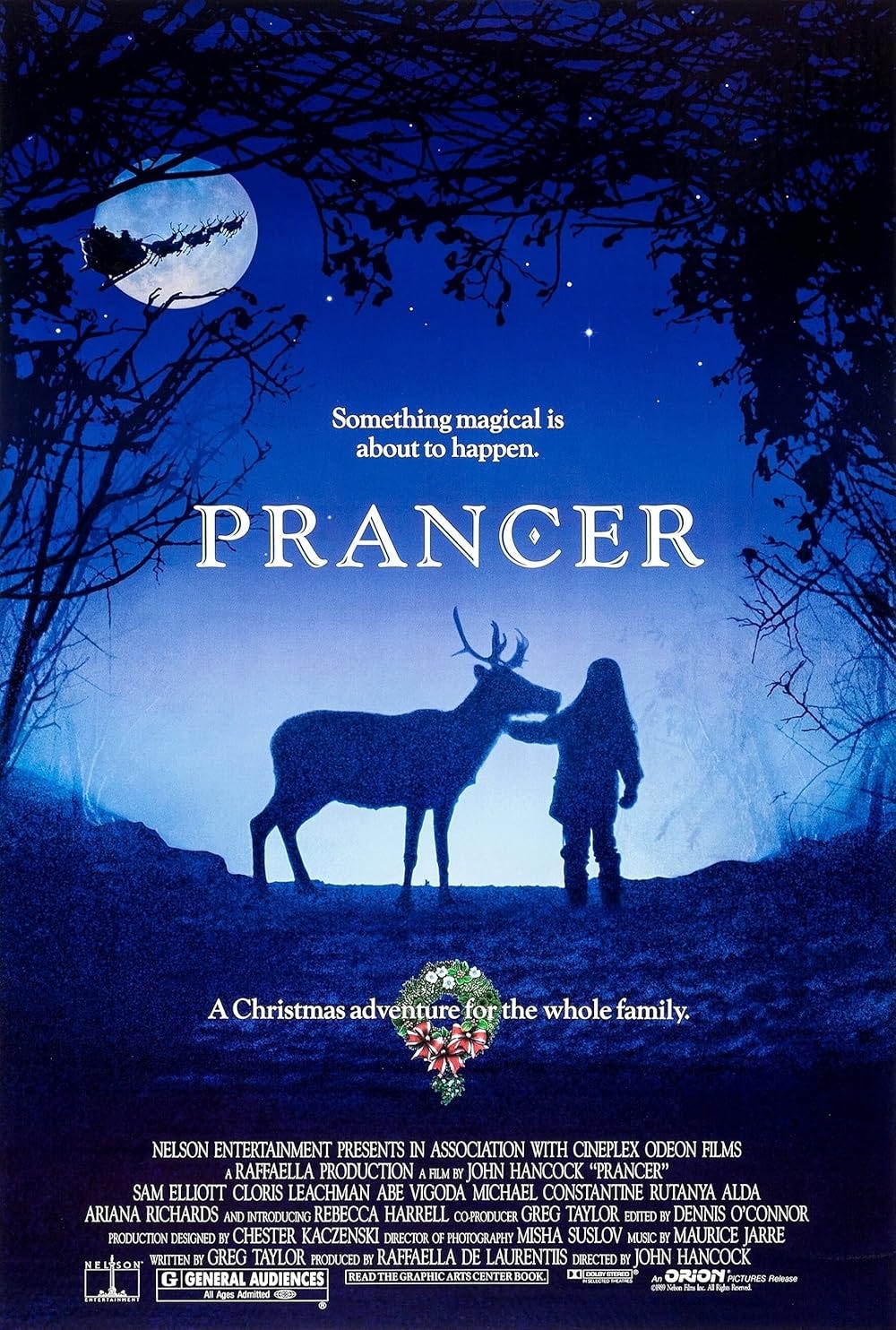
Prancer begins on a somber note. Our protagonist, 8-year-old Jessica Riggs, is a happy-go-lucky kid who’s doing her best to enjoy the holiday season. Trouble is, her mother recently died, her father John (played by Sam Elliott) is barely making ends meet with the family farm, and her aunt Sarah is insisting on taking Jessica and her brother Steve to live with her in a nearby town. A devastating but relatable combination for millions of children.
As the story unfolds and the titular reindeer comes into Jessica’s life, things briefly take a turn for the better—even though John threatens to shoot Prancer on two separate occasions and we’re led to believe that the local butcher is going to turn Prancer into venison.3 Stumbling upon one of Santa’s reindeer and nursing him back to health eventually brings Jessica closer to Steve and then to John, who has an emotional epiphany that he can live with losing the farm but he can’t live with “losing” his children.
It’s a satisfying narrative arc. And seeing Prancer fly away to rejoin Santa Claus in the night sky is a nice note to end on. But this is not exactly a “happily ever after” scenario. John’s apple farm probably won’t make a sudden turnaround—especially with the early 90s economic recession on the horizon. And John probably will struggle to raise two children by himself, relying on Sarah and others to scrape by (especially if he has to find another job).
We’re not left with much certainty that the Riggs family is going to be okay. But hope and certainty are different things.
Prancer is fantastical, but it’s not a fairy tale. Much like our own, it’s a world where sadness and despair are not eradicated but overcome, even if it’s just for a brief moment. And that’s why it works so well as a Christmas movie. The spirit of Christmas may be universal, but our experiences of the holiday season are far from it. But what the Christmas season offers is a message of hope, whatever walk of life you may be on. Hope in God or in relationships or in family, friends, and neighbors—or maybe just hope in survival. I think any of those are pretty good reasons for the season.
I’m very thankful to have experienced plenty of good fortune this year. It’s been one of the best years of my life, honestly. But throughout the year, as I’ve looked and listened and observed, I’ve often bowed my head in despair and accepted that there is no peace on earth. That hate is strong and mocks our song. But the bells keep ringing. And the reindeer keep flying. And for now, maybe that’s enough.
Prancer is now streaming on Hoopla, MGM+, and Philo, and it is available to rent elsewhere.
I’m also particularly fond of The Tide Rises, the Tide Falls, and I think those six words could make for a great tattoo, but I also don’t want people to think I support Alabama football.
Aptly enough, he wrote this poem on Christmas Day. Just like I’m writing this letter on Christmas Day. We’re the same, he and I.
Have I mentioned that Prancer is rated G? That’s some pretty heavy stuff for a child to endure! (Although I showed this film to my fiancée’s 5-year-old and 3-year-old, so maybe I have no room to talk.)
Please don't feel the need to apologize for posting a Christmas film review after the 25th. If one goes by the old tradition of the 12 days of Christmas, something I strongly advocate as it makes the whole season so much more bearable, you actually have until January 6th.
I remember this film being in theaters back in the day and I seem to recall it being something of a sleeper. I've never seen it but it sounds a lor like the sort of bittersweet made-for-televison Christmas films of the seventies that might have had a fortuitously, muted "happy" ending that was overshadowed by the sense that things weren't great and they weren't going to get any better (we really should have listened to the seventies). Coincidentally, I see that most of the cast were regulars of seventies television.
A few years back I read about Frances's death in an article somewhere online about just how highly combustible 19th century clothing was. Such deaths were sadly far from rare with women being the prime victims, especially during the holidays as they would lean in to admire Christmas trees, causing their dresses to brush against the flame of a candle on the lower branches.