
Dark Night of the Scarecrow (1981) Shows the Grim Consequences of Rural Conformity

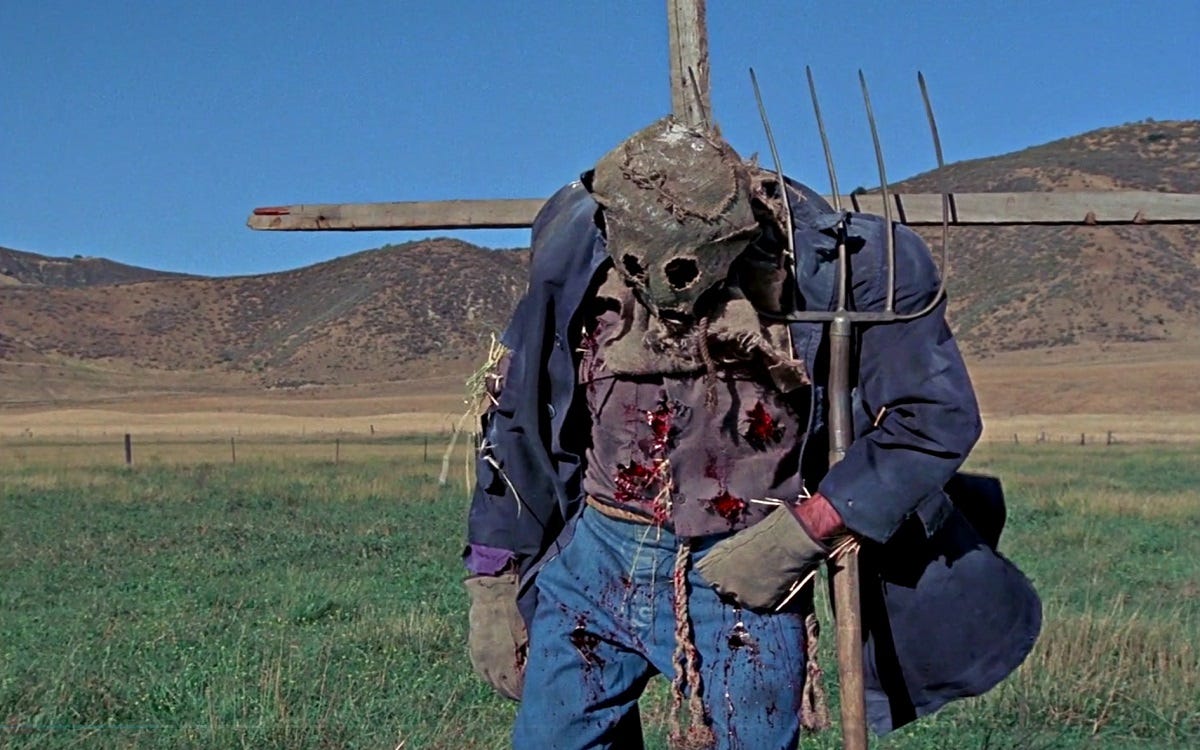
Guest post alert! For the first time since October, today’s newsletter is from a writer friend of mine: Dan Fite Jr., who made his Dust On The VCR debut almost exactly three years ago with a piece about The Country Bears. Today he’s brought us a very different kind of film—one that I’d never heard of before he requested it, but sometimes that’s the beauty of this newsletter. (And now I really want to watch it.) I’ve been living vicariously through Dan for a few years now as he chases his filmmaking dreams in Los Angeles, and if you’d like to follow his progress like I am, you can find him on Instagram or Letterboxd. Take it away, Dan!
In Burbank, California, there’s a gem of an establishment called Be Kind Video. It’s in league with this newsletter, emphasizing nostalgia for the bygone era of video store culture and providing a space for tapeheads to purchase new treasures. They also rent DVDs and Blu-rays, of course.
With an extensive selection squeezed into such a small space, one can spend hours making laps around the one-room store trying to decide what movie to take home next. A year and a half ago, I was looking for Halloween rentals and getting recommendations from the store owner, Matt Renior. Matt pointed out a title that was so corny, I couldn’t resist picking it up: Dark Night of the Scarecrow.1
At first glance, the movie is just okay at best. It’s an 80s made-for-TV horror film that boasts Charles Durning as its biggest star.2 But when you look closely at Dark Night of the Scarecrow, as I have multiple times since I first saw it, you begin to appreciate a few striking elements that set it apart. Namely, there’s a definite ring of Southern authenticity reminiscent of David Gordon Greene’s Undertow or the small-town politics of Night of the Hunter.3
It gets the South right. And any movie that gets the South right makes me wonder “What is this movie really saying about the South?”
I don’t think screenwriter J.D. Fiegelson or director Frank De Felitta set out to make any sort of statement about the South. But if you grew up in the Southeast as I did, you’ll recognize a few familiar characters. You’ve got the public servant: a mailman (Durning) who has a flawless reputation amongst the citizenry. You have the struggling small business owner: a farmer (played by Lane Smith).4 You have the resigned social drunk who gets angry over everything but cares about nothing: a corn mill operator (played by Claude Earl Jones). And of course, you have the vulnerable white trash: a mechanic (played by Robert F. Lyons).
Together, they comprise a rag-tag group of moral crusaders who operate outside the law on their own time to keep their town “safe.” One can easily picture these men in MAGA hats spouting off about “family values.” It’s like a Rotary Club taken one step too far.
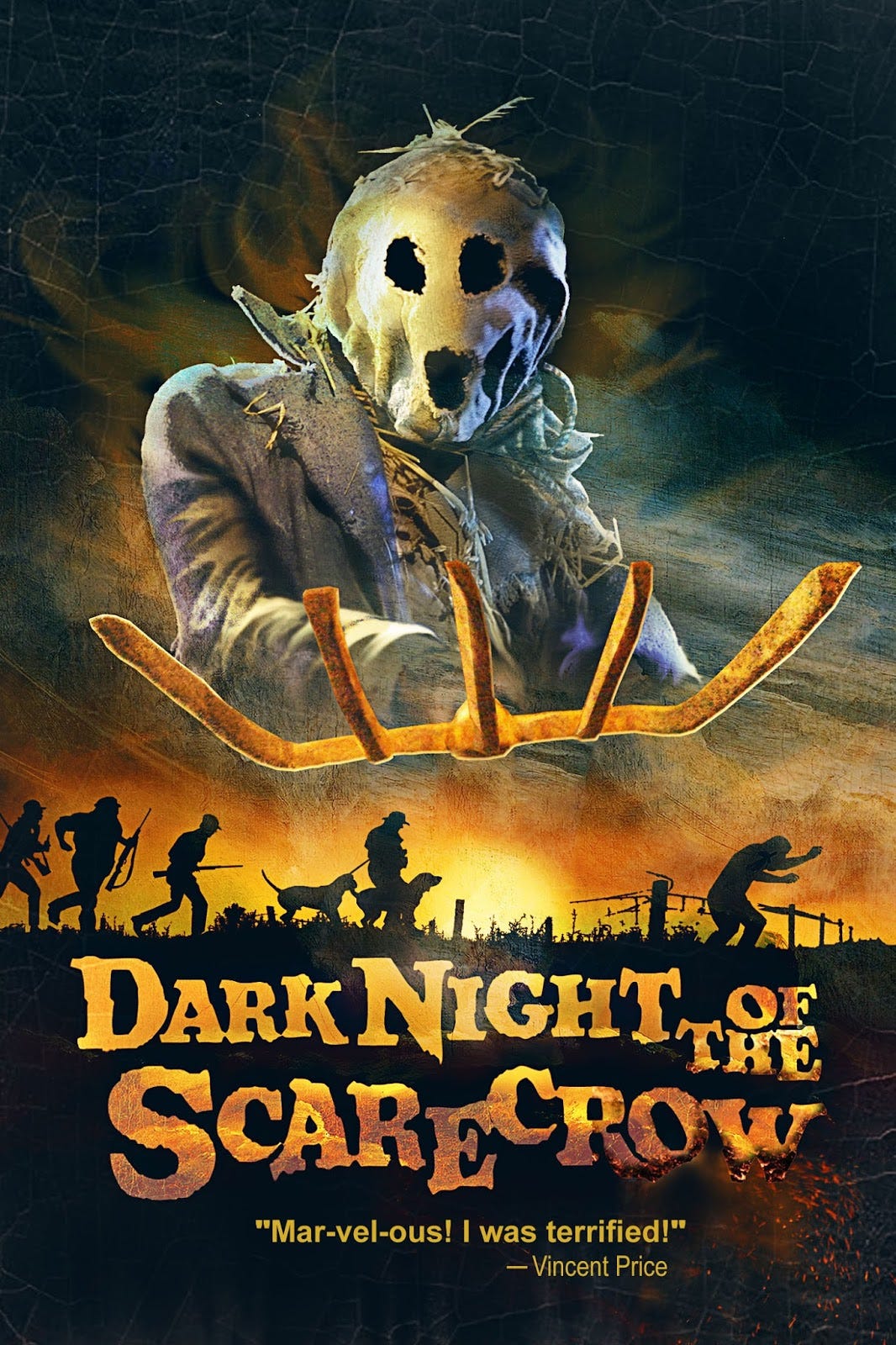
The target of this mob is a man on the fringes of society: Bubba Ritter (played by Larry Drake), a neurodivergent man who has the innocence of a child. Bubba lives with his mother and is shown from the start to be harmless. While the film’s depiction of neurodivergency certainly isn’t up to snuff—this was the 80s, after all—the characterization of this gentle giant is as sweet as can be.
Bubba enjoys a friendship with little Marylee Williams (played by Tonya Crowe), a local girl who’s attacked by a dog and saved by Bubba. Bubba is so shocked by the event that he can’t articulate that he saved her; instead, he just shows up at the Williams doorstep with Marylee’s flayed body in his arms. Bubba, being viewed as dangerous, is assumed to be her attacker.
Our “family values” crusaders jump into action without stopping to wait for facts. They’ve hated Bubba from the beginning, thinking him “dangerous” from afar simply because he’s neurodivergent. Their ignorance inspires fear, and discourages critical thinking (sound familiar?). Of course, this is the age-old story of whiteness in our world. And it’s been violently true in the American South; it’s still true in the Southeast today. These men react to a situation they know nothing about with hatred and violence, and they bring about their own doom as a result.
This film is underseen, so I don’t want to give away too many details. But I can say that when I think about Dark Night of the Scarecrow, I think about the tyranny and hypocrisy of family values. Conformity is rampant all around us, but there’s a particularly dark brand of conformity throughout most of the South (and perhaps the Midwest) that demands all-or-nothing commitment to certain ideals and aesthetics. If you don’t fit that framework, you’re dangerous. No questions will be asked. No consideration will be given. No honest conversation will be had. And at the end of the day, all it spells is doom for everyone involved.
In the age of Trumpism, Dark Night of the Scarecrow’s scenario is eerily familiar. Despite the film’s age, the most horrific parts of the film are the moments that remind us of men we all know who resemble these so-called crusaders. Which is why, despite it all, it’s very satisfying to watch them shit their pants when a scarecrow monster shows up.
Dark Night of the Scarecrow is now streaming on Kanopy, Pluto TV, Philo, and the Roku Channel, and it is available to rent elsewhere.
Pun somewhat intended.
Where are my Durning heads at? You mean you haven’t heard of Charles Durning!? He played Governor Pappy O’Daniel in O Brother Where Art Thou?, you know.
Jeremy here. Night of the Hunter was actually the subject of our last guest post, if you missed it.
Jeremy here again. This might be before Dan’s time, but my generation would recognize Lane Smith as the mean coach of the villain team in The Mighty Ducks.
 | A guest post by
|
Neeeed to see this. Probably gonna tee up a whole Vincent Price marathon, as a matter of fact; "price" myself out, if you will.
"there’s a particularly dark brand of conformity throughout most of the South (and perhaps the Midwest) that demands all-or-nothing commitment to certain ideals and aesthetics."
William Faulkner was adept at documenting this in his novels and short stories- he grew up in that milieu and could articulate its misguidedness without succumbing to it.