
Signs (2002) Is a Good Friday Movie, and I Can Prove It To You

Today’s issue of Dust On The VCR is a guest piece! If you haven’t been keeping score at home, Mary Catherine McAnnally Scott is (and kinda already was) the clubhouse leader among our bullpen of guest writers. Today marks her sixth guest piece, which means she’s compiled a veritable video store staff picks shelf of film essays including George of the Jungle, Galaxy Quest, Indecent Proposal, Road House, and Jaws. (Tell me that shelf doesn’t have something for everybody.) After dropping a Jaws piece on the 4th of July, she’s keeping it timely with this piece about Signs for Easter weekend. But wait, there’s more! Mary Catherine is now the proud owner of her very own Substack, also, also, so give her a follow and get more goodness like this delivered straight to your inbox on the regular. And if you aren’t already, give her a follow on Instagram too! And now it’s time for communion with aliens.
“I sure would feel better if I knew it was just Lionel and the Wolfington brothers.” Graham Hess, a former Episcopal priest, is standing in his cornfield looking at the crop circles his kids found.1 It’s one of the first lines of dialogue we hear from Mel Gibson’s protagonist.2
“I think God did it,” his son Morgan suggests.
Strange things have been happening around their Pennsylvania farm town. Sounds in the night. Crop circles. Animals acting funny. Later in this scene, the dog turns on Graham’s children, Morgan and Bo (played by Rory Culkin and Abigail Breslin).
Everybody has a diagnosis to explain the strangeness. Everybody has a theory that they’re certain about. It’s a capitalist conspiracy. It’s a military coup. It’s a sign from God.
As he’s getting Bo a glass of water in the middle of the night, Graham sees an actual alien, right outside the window, crouched on his own roof. “Lionel Pritchard and the Wolfington brothers are back,” Graham says as he wakes his little brother Merrill (played by Joaquin Phoenix).3 The two men proceed to sprint around the house insane with anger.4 The conflict has begun.
I first saw Signs as a seventh grader in a movie theater with all my friends, absolutely losing my mind with the kind of delightful fear that creates a bond in a dark room. (The birthday party scene!) After rewatching it a couple years ago, I realized it holds a different kind of power.
In one of the most iconic scenes in the film, Merrill begs Graham to comfort him, and Graham does—sort of—by explaining how he sees the world: Some people believe in miracles, and some simply believe in “happy turn(s) of chance.” The lighting in this scene, casting half of Gibson’s face in total shadow and half in TV light, is a Hitchcockian knockout. The shard of light glinting in Gibson’s eye on the shadowy side of his face always scared me to the core.
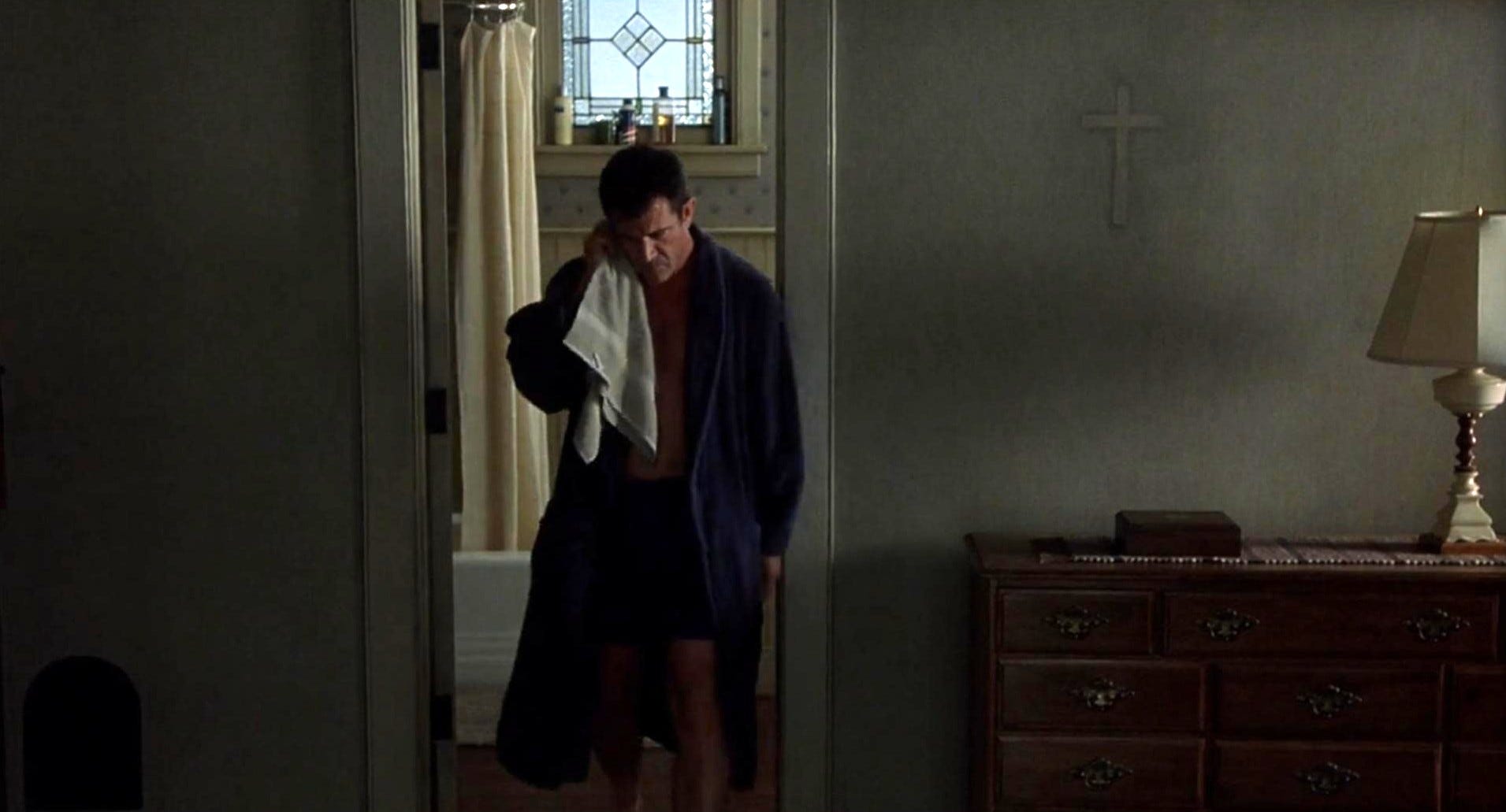
But it’s also a clear visual setup for the central problem of this movie: two sides, locked in binary. Good vs. evil. Dark vs light. Belief vs. unbelief. Graham found himself on one side of that binary before his wife died, and now finds himself on the other. All that’s left is a sun-bleached outline on his bedroom wall where a cross used to hang.
After holding it together the best he can throughout most of the film, Graham finally breaks down sobbing at the family’s Last Supper, where they each get to choose their meal.5 This is where Graham makes his first of three major character turns. His emotional breakthrough—the despair and acknowledgement that something terrible is happening, something he can no longer ignore—runs parallel to the action of the film. Where he’s been cold and detached thus far, white-knuckling through in the name of remaining calm for his children, this moment of release brings him closer to his children, whom he clutches.
To distract them and ground them in happy memories (and distract himself from his own paralyzing fear), Graham steadies himself and finds something pastoral again. As the aliens descend on their farm, he calmly tells the children stories from the day they were each born—“While they were fixing your mom up, all she kept asking about was you,” Graham tells Morgan through tears—as Merrill frantically nails boards to the doors and windows.
Once the family closes themselves safely in the basement, Morgan is the victim of a good scare and it triggers an asthma attack. Clutching a barely conscious Morgan and fearing the worst, Graham makes his second turn: “Don’t do this to me again,” Graham snarls at God. “Not again. I hate you.” He’s finally hit the bottom. His wife is dead, he’s left the church, and now there are real-life aliens everywhere. You can practically feel him conceding to a higher power.
But Graham has been to seminary, so he knows the fine print. He knows that becoming a believer again would mean admitting that God didn’t just allow his wife to die. It would mean that God took his wife. Because the horrible tradeoff of believing that God orders certain events is that you then have to concede that God orders all events. And that means that God has not just borne witness to suffering. That means that God caused the suffering. In the case of Signs, it would mean that God killed Graham’s wife so that, in her death, she could say the things that would save his children (“Swing away, Merrill”). Life taken for life given.6
Very Good Friday. Very Good Friday indeed.
You’d be forgiven for buying into this easy read of the movie. Shyamalan does kinda treat his audience like a pack of dummies who needs to be beaten over the head with a bat. God is in charge after all! Before she dies, Graham’s wife whispers that her death was “meant to be,” and it was! Everything was! Bo’s half-drunk water glasses littering every surface set the family up to dunk the aliens in their kryptonite (water!), Morgan’s asthma attack prevents him from breathing in the aliens’ poison gas, the whole “Swing away” thing, etc.
Numbed by grief, Graham lost his faith. If we’re getting Talmudic up in here, the aliens represent his inner demons, and he defeats them. He is then baptized by the (holy!) water that killed the aliens. Graham is brought back to his faith because he sees that God organized his whole life so that Morgan would live. Everything has been made right because, after Morgan is saved, Graham is once again on the “correct” side of the binary.
But it’s not that clean. And we know that because of one important detail.
In the final scene, the camera moves backward into the house through a broken window pane, and we watch Morgan recover in Graham’s arms right next to Bo and Merrill in the lush green yard. It slowly pans through the house until we’re back in Graham’s bedroom.7 We’re looking through the windows again, but at a snowy vista this time. Seasons have changed. Time has passed. We stop at the bathroom door—the same shot Shyamalan framed up to show us the conspicuously absent cross that used to hang on Graham’s wall.
But instead of a cross—a symbol of the binary of death vs. resurrection—Graham’s wall is covered with the proof of life. Real life. Messy, tangly life. A dozen family photos are framed and hung. And it’s not just the unadulterated, happy moments: His wedding portrait is among them. The dogs (who died in the alien attack, R.I.P.) are featured in a few images. All of this instead of the cross. In fact, Graham didn’t hang that cross back up at all.
Because he didn’t go back to his old belief system. He’s found something new. In his character’s final turn, he’s realized there’s a third group—one that sees neither miracles nor coincidence, or rather, sees both.
Bathed in light and serenaded by his children’s laughter, Graham puts on his watch and jacket, turning to reveal he’s wearing a clerical collar again. He slowly leaves the room, returning to work in a job where his duty is to steward the hope of the people who trust him despite knowing he can’t protect them from the inevitabilities of life’s cruel twists of fate. He’s returned to his work in the church, sure, but that isn’t the job I mean. He’s returned to fatherhood.
But he’s no longer walking around with a belief system so fragile that it can’t allow for terrible things and beautiful things to exist under the hand of the same God; that system came tumbling down when his life was flooded with grief. Now, he’s building something new—something more difficult and complicated than the “all or nothing” he’d been practicing. He and his children lived through something horrible, then something else horrible. And in order to go on, he’s folded the profound grief inherent in being alive, in being a father, into his faith.
We know this is true because Graham didn’t surrender to the darkness when the aliens descended upon his house. He clung to his children. He told them stories. He filled them with peace. He realized he has no control over what’s happening to him, only the opportunity to drop in and to feel it all. To attune himself to his reality, not lean on the belief that his reality is being attuned to him. A few months ago, there was an alien invasion. Now, there’s happiness back in his house. Next week, a new horror could unfold. But he’s come back from the proverbial grave a new man—one who sees things differently.
Maybe there are signs and miracles, an order to life’s events. Or maybe it’s Lionel Pritchard and the Wolfington brothers. Like Graham in the first scene, it sure would make us feel better to know. I think what this movie is actually asking us to wrestle with is whether it matters at all to be certain when the price of certainty is so punishing. It seems to say that we can waste away clinging to beliefs as vulnerable as tissue paper or we can throw our arms open and surrender.
Real meaning isn’t found in certainty. It’s found in the willingness to keep living when we don’t have any answers—when the cross is off the wall, so to speak. When all we can do is tell our children the stories of their birth as the sky is falling and hope to land on the idea that, whatever tomorrow brings, the best proof of God we can ask for is to hear them laughing in the next room.
Signs is now streaming on AMC+ and Philo, and it is available to rent elsewhere.
I initially wrote that Graham was a defected Catholic, but I was corrected by my husband who said "He can't be Catholic because he has kids." Are you lapsed or not, Jordan? Pick a lane!
Damn, I miss Mel Gibson. I know he's a problem, I'm not asking for him back, but peak Mel Gibson (The Patriot, What Women Want, Braveheart) was untouchable. He was so damn good. It sucks that he sucks.
Lionel Pritchard and the Wolfington Brothers would be an amazing band name.
There’s an incredible comedic chemistry between these two in a movie that is really not funny.
Much like Kevin’s untouched mac and cheese in Home Alone, their dinners go tragically uneaten on the table when the family eventually shelters in the basement.
Reader, if you feel that I've taken us somewhere dark, you are right! But for what it’s worth, I don't believe God is omnipotent, I believe God is omnibenevolent. I'd rather believe in good than "pre-ordained suffering," ya dig?
The James Newton Howard score is truly stunning in this moment, by the way.
 | A guest post by
|
Pfewwwee, this article will preach. Stepped on some toes AND pulled some heart strings. Strong stuff. Great job.
Great read! One of my favourite films which still haunts me today, although for more reasons than the aliens now.