
I Think It’s Fine That Zach Cregger Has Never Seen Resident Evil (2002)


Reader, I just did something that I swore I’d never actually do, especially in my old age: I watched every single Resident Evil movie this summer.
I can thank/blame my wife in this case, at least. We had the house all to ourselves on a Saturday night in June, so we DoorDashed a plethora of sushi and plopped onto the couch. She’s a fan of Resident Evil, and I’d been itching to watch it for the first time in a couple decades, so we threw it on. Then we got really crazy and immediately fired up the sequel, Resident Evil: Apocalypse, a few minutes later.1 Despite a marked drop in quality from the first film to the second, it was a perfect lazy summer evening.
And then I just…kept going. Sara has seen most of the sequels before, and she is smarter than me, so she only occasionally tuned in after that. But I had to know for sure if these movies—which will be up to a surprising eight entries next month—had any lasting value. Despite Paul W. S. Anderson’s six films all earning a healthy return at the box office ($300 million worldwide in two cases!) and a hive of staunch defenders on Letterboxd, I’ve come to the conclusion that this franchise is, on the whole, quite poor.2
I have a feeling that Zach Cregger, this decade’s biggest indie horror darling, would agree with me. But we may never know. Because he’s never seen a Resident Evil movie. Other than the one he just made, I suppose.
I have heard tell that certain digital circles of Resident Evil fandom are not happy about this. Which is par for the course in this day and age when franchises increasingly rule the box office and fan culture increasingly drives the franchises. The average viewer wants to be placated rather than challenged. Audiences at large would rather seek comfort in the familiar than journey into realms of the unknown.3
Applying this attitude to the Resident Evil franchise is a bit ironic then. Because these movies diverge wildly from the video games that they’re based on.
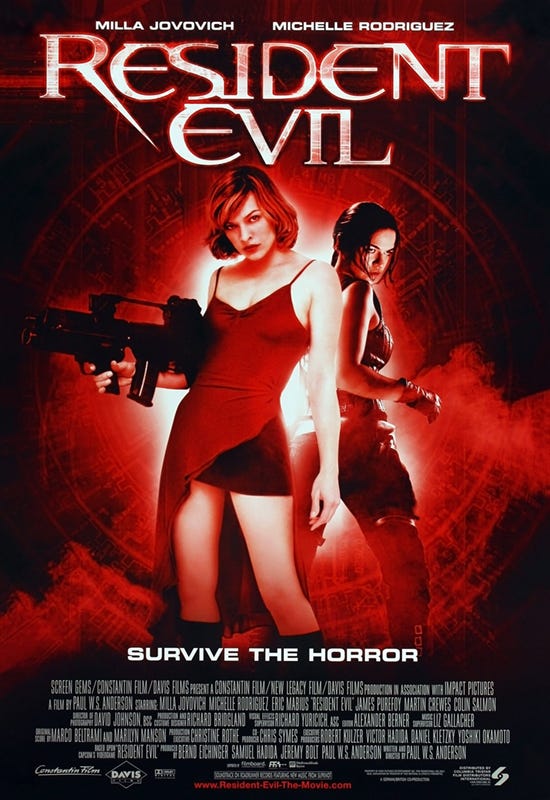
By the time Resident Evil hit theaters, four different games had already been released, and a remake of the 1996 original was dropped almost concurrently with the film. It was already a beloved game series, coining the term “survival horror” and paving the way for a multitude of similar titles.4 Naturally, gamers lined up to see it, and despite mostly negative reviews, it earned a respectable $103 million worldwide.
But it wasn’t like the games at all. It was more of an action flick than a horror movie, and it only drew from the world of the games rather than the actual storylines.5 Even the Milla Jovovich protagonist, Alice, was a wholly new character. In fact, none of the characters from the game were in the film.
And that’s fine. It was perhaps not the product that most viewers expected, but it was a product that they largely enjoyed. They expected pasta and were given a pizza, but that pizza was good enough to spawn another half dozen pizzas.
So we could (and perhaps should) simply dismiss any anti-buzz around Cregger’s Resident Evil given that he’s reportedly attempting to adapt the vibe of the game more faithfully than Anderson cared to.6 But I think this discourse raises a question worth considering: What’s the purpose of an adaptation anyway?
Some viewers inevitably will want the adaptation to be strictly faithful to the thing they love, whether it’s a book or a video game or a TV show or a toy. And while that desire can be easy to oversimplify and dismiss, I’m sympathetic to it. If the adaptation doesn’t work for us, we still have the original thing to cherish, of course, but discussing and sharing that love becomes more complicated when the newer, bigger, shinier thing must be acknowledged and compared. It can be frustrating! And telling everyone “The book is better” can make you sound like a snob. That’s all on top of the baseline disappointment that comes from unmet expectations for an adaptation.
But faithful can’t be the only approach, right? Because if it is, then Resident Evil (2002) failed, and Resident Evil (2026)—which also takes place in the world of the games but doesn’t incorporate their characters and storylines—will too. And one can’t be written off without writing off the other as well.
Conveniently, this discourse is running parallel to another minor cinematic controversy. Christopher Nolan’s The Odyssey is going to cross the $1 billion mark this weekend. But Nolan’s success didn’t come without its fair share of detractors—namely Emily Wilson, whose 2017 translation of Homer’s epic poem was one of the foundations for his new adaptation. Wilson penned some harsh criticisms of Nolan’s film upon its release, and then she doubled down on her critique earlier this week. If anyone’s entitled to opinions like these, it’s her, of course.
It reminds me of Stephen King’s infamous dismissal of Stanley Kubrick’s The Shining. Kubrick strayed too far from the novel in his screenplay, and King simply didn’t appreciate that. (Again, he’s entitled to that opinion; the film wouldn’t exist without his source material.) It might be reductive to sum up Wilson’s takedown as “He changed too much and I didn’t like that,” but at the end of the day, they’re two people interpreting a millennia-old saga for modern audiences. Maybe it’s for the best that they took two different paths and agreed to disagree.
There’s also the issue of adaptability, of course. All three of these examples faced that challenge. How else was Nolan supposed to wrap a relevant theme around an ancient episodic tale and fit it into a three-hour window? How else was Kubrick supposed to turn King’s novel full of abstract and internalized horror into a cinematic experience? And how is anyone supposed to turn a video game—especially one where you mostly wander around shooting enemies, solving puzzles, and collecting items—into an actual movie?
I don’t think there’s a wrong answer, especially when there’s not an easy answer. And I think it’s smart of Cregger to not study someone else’s answers before taking his own test. Considering that he aced his first two assignments, I’ve got a pretty good feeling he’ll pass this one too.
Resident Evil is now streaming on Tubi, and it is available to rent elsewhere.
I think they jumped to “Apocalypse” way too quickly for these Resident Evil colonified subtitles. You need to work up to something like an apocalypse. Especially if you’re going to use a subtitle like “Extinction” for the third film, which is too synonymous with its predecessor. And then there’s an “Afterlife” two films before a “Final Chapter,” which doesn’t make much sense to me. (Resident Evil: The Final Chapter was, to its credit, the final chapter for Milla Jovovich and the other characters.)
The seventh film, Resident Evil: Welcome to Raccoon City, is actually my third favorite of the series. I think Johannes Roberts is a pretty sturdy director. It only made $42 million worldwide against a $25 million budget, though, so Sony sent him packing.
This is how I know that WALL-E isn’t 100% a future documentary. When we leave Earth and go to the spaceship and the robots tell us “Try blue. It’s the new red!” there will be a big angry stupid pro-red uprising and the computer will quickly turn and say “Actually, remember red? We love red, don’t we?”
I happen to love many of the Resident Evil games—especially the second, fourth, and eighth games—but I think I might enjoy Silent Hill 2 more than any of them. We’re not going to talk about Return to Silent Hill.
Cregger says in his interview that this lean into action rather than horror is the main reason he never watched the Resident Evil films, noting that they look to him like they’re riffing on The Matrix too heavily. And he’s not wrong. One of the sequels even tries (poorly) to do the bullet time thing.
Cregger has been doing a lot of interviews over the past couple years, and I’d highly recommend checking them out whenever the algorithm serves them. He’s so good on the mic.
I straight think that’s a good thing lol
Having studied game design and made a solid 70% of my total accumulated living in film criticism, I can tell you that no sentence so consistently metastasizes into a weak take on film quite as hard as those that start with "As someone who played the games..."