
Pumpkinhead (1988) Proves That All You Need For a Spooky Movie is a Creepy Poem

Reader, I am writing a new screenplay.1 Right now, I’m in the early stages, which means I’m indulging in one of my favorite research activities: crafting my movie diet around films that might inspire or influence the one my crew and I are working on. Along with rewatching some old favorites, I’ve crossed off films I’ve always meant to see (End of Days, Tenacious D in The Pick of Destiny) along with some films I was never meant to see (Left Behind).2
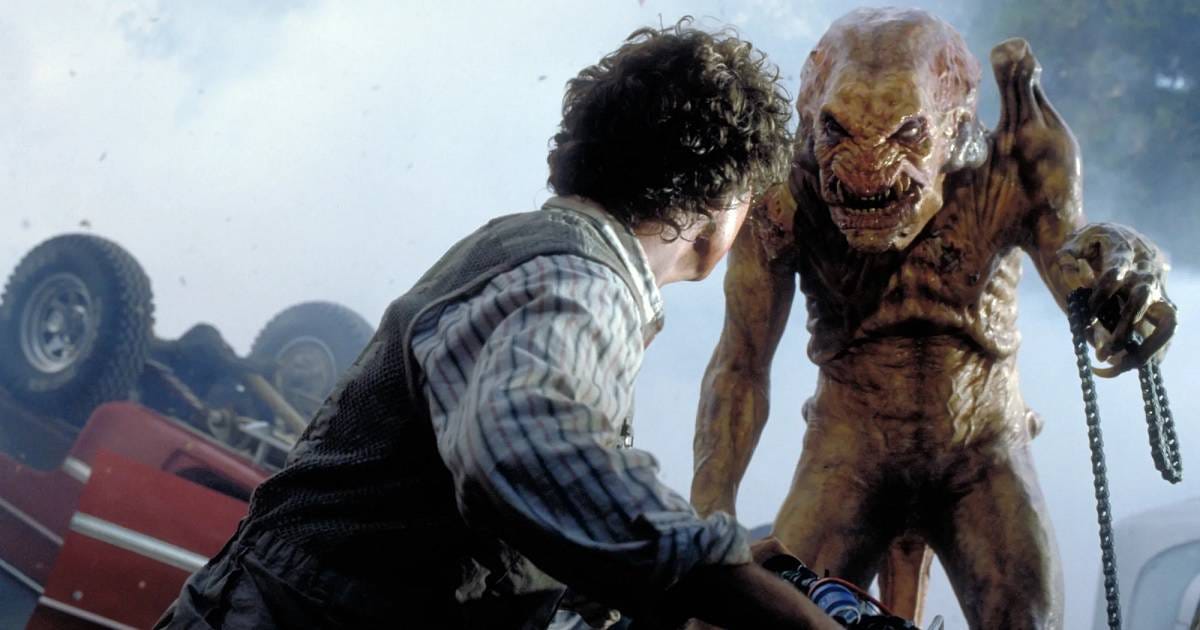
The one that’s stuck with me the most on this research journey has been Pumpkinhead, a film that I should’ve seen 25 years ago but somehow never caught up with until now. What a delightful film. It’s a campy but affecting story of a grieving father who compels an Appalachian witch to summon a hulking demon creature so that he can get revenge on the people who killed his son. The cinematography is gorgeous, the creature effects are superb, and Lance Henriksen is truly committed in the lead role.3
But a curious detail from the opening credits has stuck with me: It’s based on a poem.
We’re not talking about an epic poem like The Odyssey or The Green Knight. It’s more like a short but spooky nursery rhyme, one only capable of setting a tone rather than spelling out a plot.4 Here it is in its entirety:
Keep away from Pumpkinhead,
Unless you're tired of living,
His enemies are mostly dead,
He's mean and unforgiving,
Laugh at him and you're undone,
But in some dreadful fashion,
Vengeance, he considers fun,
And plans it with a passion,
Time will not erase or blot,
A plot that he has brewing,
It's when you think that he's forgot,
He'll conjure your undoing,
Bolted doors and windows barred,
Guard dogs prowling in the yard,
Won't protect you in your bed,
Nothing will, from Pumpkinhead!
A nice little cautionary tale, isn’t it? There’s something about that first couplet that really resonates with me. “Unless you’re tired of living” has some real existential weight to it for a rhyming poem for kids.
At first I struggled to think of other feature films that are based on poems. Jabberwocky is a pretty clear comparison; it’s about the same length, and it laid a similar foundation for Terry Gilliam to build upon. Then there are children’s books that essentially function like poems, especially the oeuvre of Dr. Seuss.5 And of course there are all of those Edgar Allan Poe adaptations, many of which star the iconic Vincent Price.
If you look back to the days of early Hollywood, studios were greenlighting all kinds of projects based on poems. Literary icons like Alfred Lord Tennyson and Henry Wadsworth Longfellow were getting the cinematic treatment when poetry was popular intellectual property.6 Anything that would get people in the theaters.
But Pumpkinhead feels just a little different. Its origins are a bit…eerier.
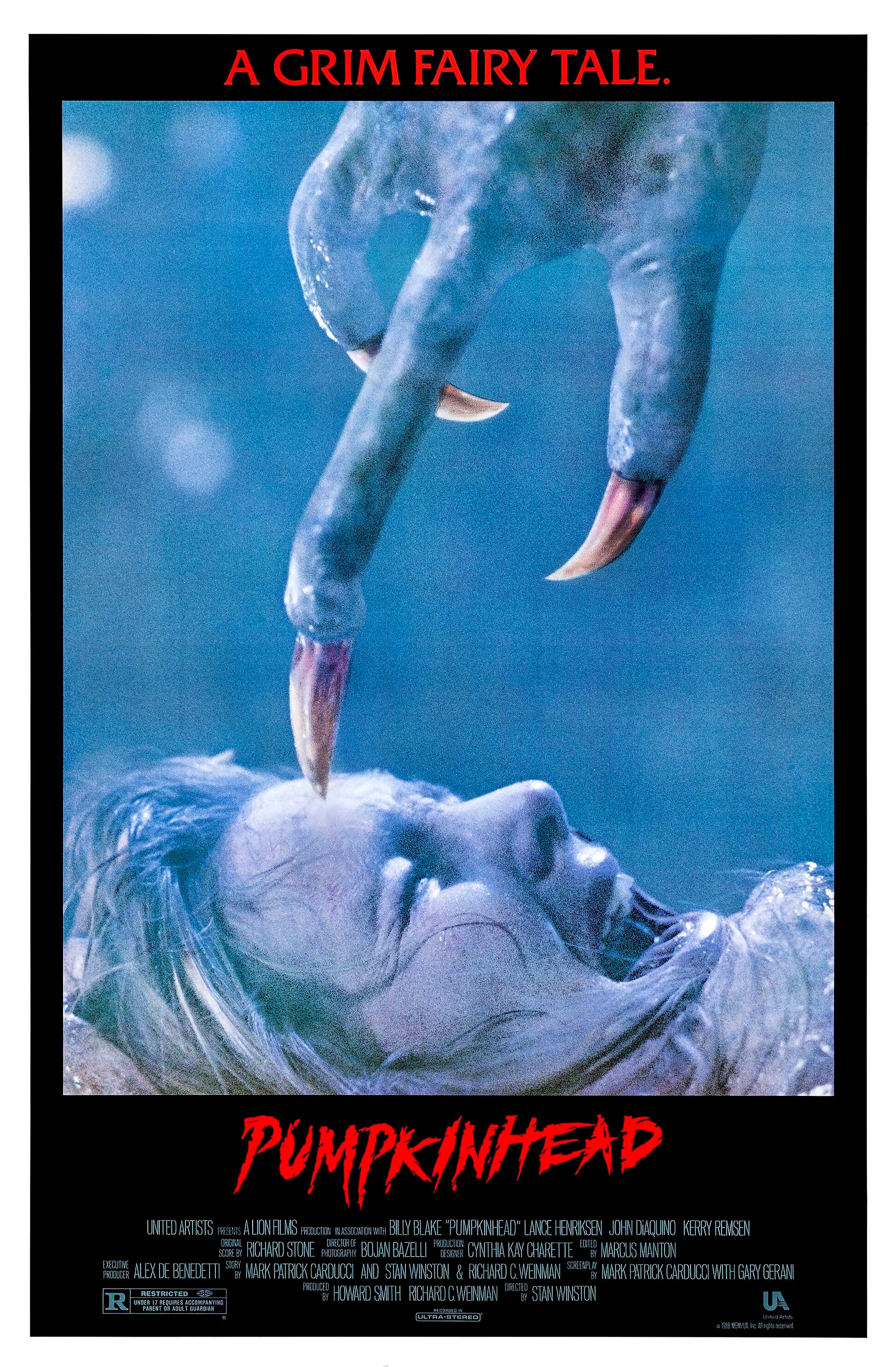
After watching the film, I sought out and read the titular poem, which made me eager to look up some other poems by Ed Justin, the credited author. But there are none to be found. There’s no Wikipedia page for Mr. Justin, no biographies from the Poetry Foundation or the Academy of American Poets, no useful search results to be found. Clearly this man wasn’t a career poet—which is probably why he chose to be credited by what I have to assume are his first and middle name.
I did find a semblance of a Pumpkinhead orgin, though. As the story goes, Ed worked in the film industry, and he was a friend of eventual Pumpkinhead producer Bill Blake—not to be confused with William Blake, who was a career poet, and one of my favorites. Ed had passed along this creepy quatern that he’d written to scare his children, which was normal parent behavior in the 80s.7 Bill saw cinematic potential in the horror lullaby and bought the rights to it from Ed.8
I have to give credit to Blake here for good producing. I’d bet that he wasn’t much of a poetry hound, but he probably knew a good name when he heard it, and “Pumpkinhead” is a memorable and evocative title. And he knew what to do with it too. The screenplay by Mark Patrick Carducci and Gary Gerani was originally called “Vengeance: The Demon,” which is not just a bad title, it’s basically two bad titles strung together by a colon.9 It’s so bad that it gets worse as you read it.
So Justin was a filmworker and not a poet. But when I went to IMDb to see what other credits he might have, I once again came up with nothing. “Ed Justin” wasn’t just a pseudonym—it was a misdirect. This text might be his most noteworthy cinematic contribution, and he seemingly wanted no credit for it.
At this point in my quest, I did what any logical person would do: I checked to see if Ed Justin’s name is an ominous anagram.
With only eight letters to work with, there weren’t any good results. “Deist jun” could be seen as some sort of summertime theology, but it’s a stretch. However, if you expand “Ed” to “Edward,” the results get much more interesting. “Adjured twins” has some merit to it; Pumpkinhead and the witch who summons him could be seen as the “twins” who are “adjured” (“commanded” as the “penalty of a curse,” according to Merriam-Webster). Or perhaps it’s Henriksen’s character (who is also named Ed, by the way) who’s one of the twins. “Dawned jurist” is a fun one too, as if Pumpkinhead has awoken to judge (and condemn) a group of people found guilty of reprehensible crimes. And of course I particularly enjoyed “adjust rewind,” given that it invokes two of the functions of a VCR.10
But “readjust wind” stuck with me the most. If our universe is chaos and we’re all arbitrarily assigned joy and tragedy, then Pumpkinhead—being a demon of vengeance that can be summoned at will—can be seen as a force of nature able to “readjust” the “wind” of justice.
By that token, could it be that Pumpkinhead is an allegory for the act of adaptation itself? Perhaps Henriksen’s protagonist represents the writer, one driven by a desire to see the world in a different way. The witch would be the director, then, the person with the power to take an idea and turn it into a production. And that would make Pumpkinhead the cast and crew as a whole, sent forth by those in charge to carry out every task necessary to fulfill the creative vision.
Or perhaps no one was ever meant to think about Pumpkinhead on any semblance of scholarly terms. But hey, if a 16-line poem can conjure an 86-minute movie, why not a 1,100-word newsletter, right?
Pumpkinhead is now streaming on Shudder and the Roku Channel, and it is available to rent elsewhere.
Yes, I am indeed collaborating with the team that brought you Don’t Die. Which is now available to rent or purchase in the United Kingdom, by the way! (And elsewhere soon!)
I watched the Nic Cage version of Left Behind, which seemed like the right thing to do at the time, but now I’m not so sure.
Award-winning filmmaker and friend of the newsletter Brandon Colvin said that Henriksen turns in “one of the best ever horror film performances” here, and I think he might be right.
The Misfits did write a song called “Pumpkinhead” where they pretty much recount the plot of the film in the verses. It’s a pretty good song in spite of this lazy lyricism.
This fact was pointed out to me by my fellow copywriter and friend of the newsletter Audi Barnes, who coincidentally forced me to watch and write about The Cat in the Hat, which unfortunately has become one of my most popular posts.
For generations, my mother’s side of the family has passed down the fact that we’re related in some capacity to Henry Wadsworth Longfellow. I bet he would’ve enjoyed this newsletter.
Turning bedtime stories for children into fully drawn fantasy worlds is how we got Lord of the Rings and Winnie the Pooh, of course. I wonder what Pooh would do if he met Pumpkinhead.
I really need to know how much Blake paid Justin to use his poem, because there’s no way he got paid enough. It may be “just a poem,” but it’s the heart of the story. Heck, a family of creepy kids even recites it in the film.
“The Demon” by itself could be a good title in the right hands. But it’s still not better than “Pumpkinhead.”
Perhaps the best and most useless anagram on the list was “DJ Underwaist,” which would be a cool name for an Australian DJ. (It just feels Australian, doesn’t it?)
😘
Always wanted to watch this! Stoked to hear it's worth it.