
Flashpoint (1984) Provides More Evidence That Crime Thrillers Are Better in Texas

Today’s issue of Dust On The VCR is a subscriber request! This film was brought to you by Charlotte Simmons, one of the first film peers that I really connected with here on Substack thanks to her thoughtful criticism. Reading her work makes me wish I was back in graduate school (complimentary). Charlotte posts regularly from her newsletter, The Treatment, but she just launched something I’m even more excited about: a script consulting service! I can personally attest to the value of her feedback, as she read through an old screenplay of mine that I return to every year or so and gave me notes so invigorating that they made me feel like the story was brand new again. That’s powerful stuff, folks. If you’re a screenwriter, a session with Charlotte would be worth every penny. If you’re merely a screenreader, then read The Treatment!
Wanna request a film for a future issue of Dust On The VCR? Subscribe to the paid version!
Last year, on the Ides of March, my girlfriend and I drove to a wedding in Clayton, Georgia. Before we left, I did a quick search to see if any films had been shot on location there. To my delight, I discovered that Grizzly was filmed in and around Clayton, so I watched it before our trip and wrote about it after we got home.
This year, on the Ides of March, my wife and I flew to a wedding in Grand Prairie, Texas. My pre-travel movie research process was the same, but it yielded fewer results this time. Some newer films that I like, such as VFW and Never Goin’ Back, were shot on location in Grand Prairie, but when you narrow the list down to the “VHS era” for the purposes of this newsletter, the pickins were slim. Every qualifying film appeared to be hard to find.1 Some of them were hard to find and seemed rather problematic.2
Luckily, Flashpoint found its way to me.3 It’s a bit lost to time, holding the trivial distinction of being HBO’s first theatrical release—and thus its first financial failure. Flashpoint earned $3.8 million at the box office against a $10 million budget. But perhaps HBO wasn’t accounting for their cable product to make all of its money back in theaters. I bet it was a hit at home.
I’ll tell you what this film is, though: It’s Texas as hell. In ways that I couldn’t have imagined.
Let’s get one thing out of the way first: Flashpoint wasn’t actually filmed in Texas. It was shot in Arizona—mostly in Tucson with some exterior scenes in the Sonoran Desert and the Sierrita Mountains. But if you’ve driven through the American Southwest, you know that it’s close enough thematically.4 I have many thoughts about whether a film’s narrative setting or shooting location should define its place, but that’s a conversation for another day. I’m declaring it Texan.
Like all good Texas-set crime thrillers, Flashpoint makes expert use of its location—in more ways than one. The story follows two U.S. Border Patrol agents named Bobby (played by the always magnetic Kris Kristofferson) and Ernie (played by the ever underrated Treat Williams). Setting a film on the U.S./Mexico border opens up a lot of interesting plot avenues, and though this film doesn’t see all of them through, it does leave one hanging over the action: A new life is waiting just a few miles south. No matter what sort of carnage ensues, there’s always an escape route beckoning to characters in peril.
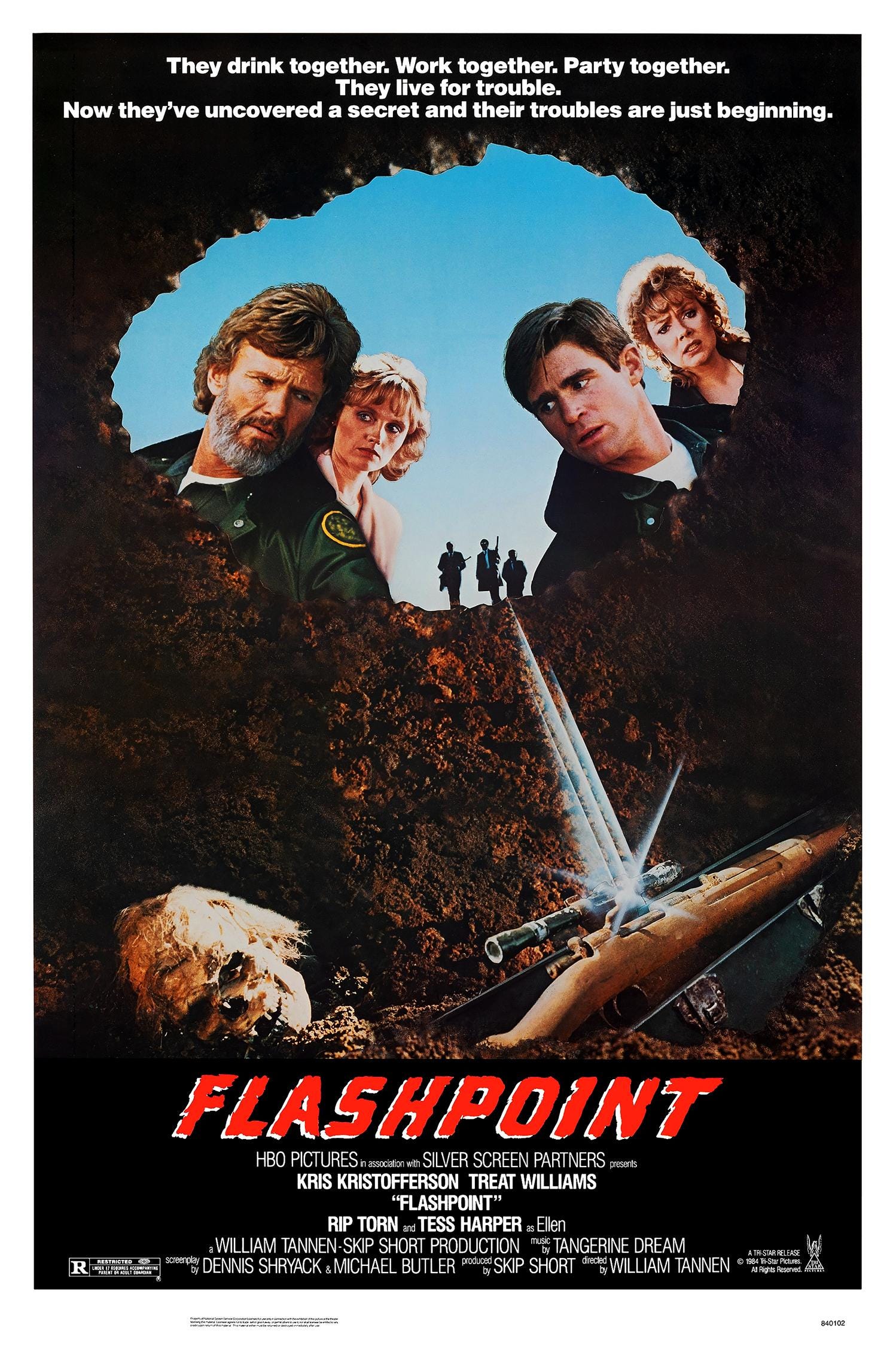
The geography is also the primary catalyst for the action in this case. Early on in the film, Bobby and Ernie are tasked with planting motion sensors in the remote parts of the desert, and wouldn’t you know it, Bobby stumbles upon something rather interesting. As we see in the film’s cold open, a Jeep goes careening off a mesa during a hard rain and lands in a gulch, where the driver is killed upon impact.5 If that wreck happened in a city or even on flatter ground, it gets discovered within a day or two at most. Case closed.
But because this is Texas, more than 20 years have passed by the time Bobby unearths the Jeep. And what he finds inside is pretty much what you’d expect from a border runner: $800,000 in unmarked bills, a sniper rifle with ammunition, an old driver’s license bearing the name Michael J. Curtis, and a piece of paper with two phone numbers on it. All that’s missing is a bounty of drugs, but this isn’t that kind of crime thriller.
As the story unfolds, the Texacity continues to come into play. Bobby and Ernie are doing their best to dodge anyone that could put a stop to Bobby’s plan—which is to split the money and flee, of course—and the desert backdrop does a lot of the heavy lifting to illustrate their plight. These two men are up against a band of federal agents who will stop at nothing to recover that evidence, and the cinematography really emphasizes just how alone they are, from wide shots of tan vistas to driving sequences along dusty dirt roads. It’s an unforgiving place, and they know it. Nobody found that Jeep for two decades, so who would come looking for two low-ranking Border Patrol agents?
Texas crime thrillers often lean into local lore in interesting ways as well. And that’s where Flashpoint sticks the landing with a plot twist that I didn’t see coming even though it was right in front of my face.6
When the climactic showdown has concluded and Bobby is the last man standing, a local sheriff (played by Rip Torn, who is absolutely throwing heat in just a couple of scenes here) arrives to reveal the big cover-up. The federal agents weren’t just trying to get that $800,000 for themselves—Michael J. Curtis was John F. Kennedy’s assassin, and the sheriff had been involved in a government conspiracy to pay him off and secure his passage to Mexico. And now that they’ve framed Bobby for murder, he knows he has to cross that border himself.
Flashpoint is the sort of film that crawled so that films like No Country For Old Men could fly.7 And the wisdom of the latter is true in the former: “This country’s hard on people. You can’t stop what’s coming. It ain’t all waiting on you.” Whatever their motivations may be, there’ll always be something compelling about men on the run across the Southwest landscape.8 Something that a green screen will never be able to capture.
Flashpoint is now streaming on Cinemax, which you can subscribe to through Amazon Prime or AppleTV.
These films include The White Lions, Fugitive Among Us, and The Beasts Are on the Streets. I would have absolutely watched and written about The Beasts Are on the Streets if it was streaming anywhere. It sounds like a fantastic pretty good movie. (We need a streaming service for old TV movies.)
These films include Corky, which has a huge Confederate flag on its poster; Indian Paint, wherein white actors play indigenous peoples; and Bells of Innocence, a faith-based horror movie where Chuck Norris plays an angel.
Charlotte gave me this recommendation a few days before my trip, and while I wasn’t planning on watching it immediately, I knew I had to watch it in Texas to heighten the experience. I’m really glad I did.
I reserve the right to contradict myself in the past and the future when complaining about any Alabama-set films that were shot in Georgia or Mississippi.
I am not well-versed in topography, so I could be using the wrong terms here. But “mesa” and “gulch” felt more Texan than “cliff” and “ditch.”
Maybe I should’ve paid more attention in my American history classes.
In another bit of pleasant synergy between the two films, Kristofferson’s love interest in Flashpoint is played by Tess Harper, who played Tommy Lee Jones’ wife in No Country For Old Men. She hasn’t worked much the past several years, so I hope she’s enjoying her retirement.
It’s always men getting into these big dumb messes, isn’t it? We do it to ourselves.
“(We need a streaming service for old TV movies.)”
Ain’t it the truth!
Cheers, Jeremy! I've only recently begun to really think about the intersection between geopolitics and dramaturgy that cinema seems to have free real estate over, and this cracked that neural pathway wide open.
I'll be writing about Flashpoint myself relatively soon I think, but the gist of what grabbed me about it was how deeply it understands the role that murder, subordination, and nobodyhood all play in the American establishment. And as I'm writing this, what I also find fascinating is the specific set of narrative advantages afforded to stories with low-spec genre engines; I think they optimize for readings like ours.