
I Have Come to Terms With Robert De Niro’s Southern Accent in Cape Fear (1991)

If there’s one thing I know about my fellow Southerners, it’s this: We’ve all got opinions about our accents.
Some of us lean into our native tongues and speak (and sing) with pride. Some of us study them, able to point out the phonetic differences between a Tennessee twang and a South Carolina drawl. Some of us try to cover them up to try and sound “smarter” when we move away for college or work. And some of us don’t think we have one at all until we visit the Northeast or the Midwest and the locals let us know that’s not the case. Even the word “accent” sounds like it was designed to be spoken by a Southerner.1
It always comes to pass, then, that we have hot takes about non-native actors portraying Southerners in movies, plays, and TV shows. It’s the sort of thing that can spawn entire articles if the performance has a wide enough reach. And it’s enough to ruin some folks’ opinion of a performer if we think they didn’t pull it off.2
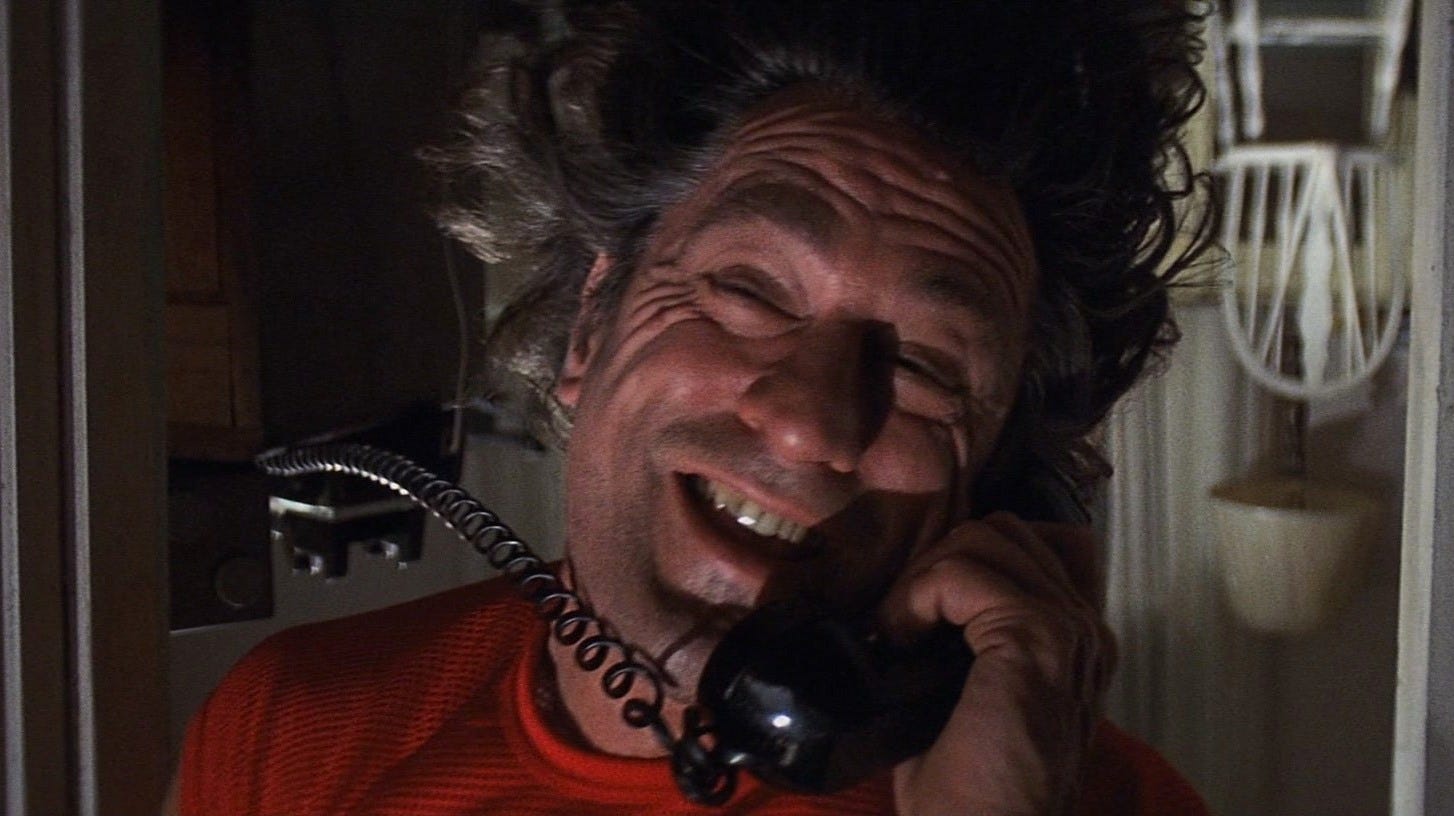
Whenever this discourse hits the mainstream, it kinda makes me wish Martin Scorsese’s Cape Fear had happened in the digital age. There would’ve been pitchfork-wielding mobs ready to tar and feather Robert De Niro for his rendition of Max Cady, a violent and relentless ex-convict with a Georgia accent.3
If you take De Niro’s performance at face value, the mobs have a point. It’s a pretty awful attempt at faking the regional dialect. As much as I love the guy—it’s hard to argue that he’s not one of our greatest living American actors—he is at his best and most comfortable when he’s playing a New Yorker. Which makes sense, given that he has lived virtually his entire life in the City. And as any Southerner will tell you, Atlanta is—geographically, sonically, conceptually—a long way from New York.
In short, Scorsese should’ve cast someone else if he was going for authenticity. But this notion begs a very important question: Why would he go and do a thing like that?
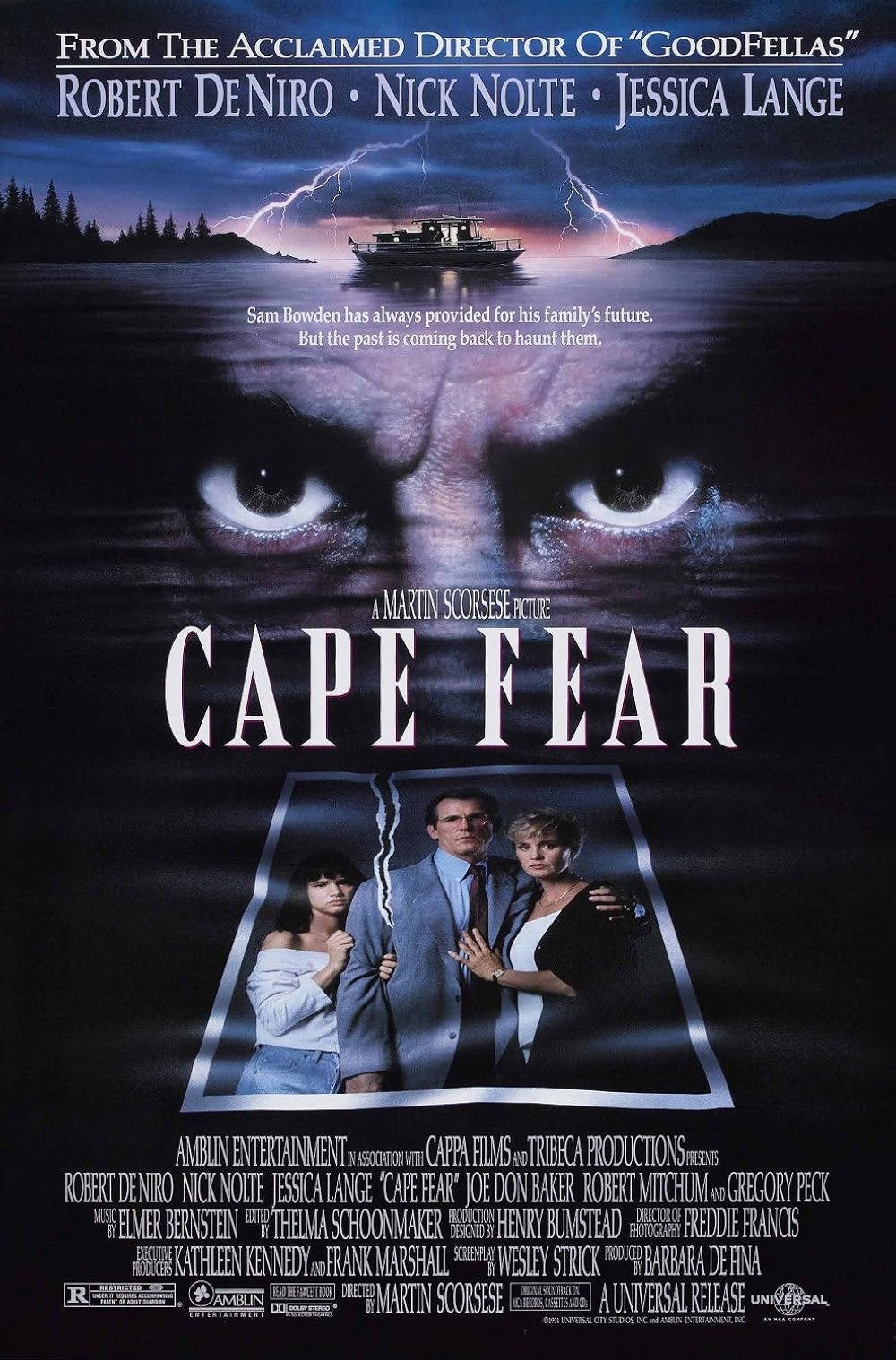
When you consider how this project landed on Marty’s desk, it sounds like the Hollywood equivalent of a blockbuster trade in professional sports. Nearly three decades after the original Cape Fear, the screenwriter of Arachnophobia wrote a new (longer) version, and his script made it all the way to Steven Spielberg.4 As the story goes, while the project was in development, Spielberg decided it was too violent for his taste, so he offered it to his pal Scorsese in exchange for a project he’d also developed and decided not to make—a little film called Schindler’s List.
What a swap that was. Spielberg added a missing piece to his roster that propelled him on a championship run—Schindler’s List earned him Oscars for Best Picture and Best Director for the first time—while Scorsese took on draft picks and dumped salaries that allowed him to build for the future.5 At face value, Steven seems like the obvious winner here, but this wasn’t a passion project for Marty; he felt he owed Universal after they supported him in the midst of the controversy surrounding The Last Temptation of Christ. Also, if we look at the analytics, the rewatchability quotient is night and day.
So Martin Scorsese, already one of the greatest American directors of any generation, has a pulpy genre picture land in his lap. What’s he supposed to do, pretend he’s adapting Shakespeare?
He did what most of us would’ve done in that situation, I think. He called up his old friend Bobby—whom he’d already worked with on six films at this point—and pitched him a part that he could really sink his teeth into and have fun with.6
The result wasn’t a masterpiece, but it might’ve been the heat check that they both needed. Scorsese made “one for them” before pivoting to something completely different with The Age of Innocence. Meanwhile, De Niro put on significant muscle, slapped on the most generic prison tattoos you’ll ever see, and became a walking hillbilly caricature. I doubt he did much accent research beyond maybe watching Gone With the Wind.
De Niro’s impression of a Southern man is directly at odds with the other more natural accents in the film. Nick Nolte and Jessica Lange grew up in Nebraska and Minnesota respectively, and while those states are also pretty far from Georgia, you could see how their regional dialects could translate well to the Southeast. Meanwhile, Juliette Lewis was just a teenager from Los Angeles, so I’m betting she was (wisely) not asked to do much. De Niro lays it on much thicker, chewing the scenery with every line and standing out in stark contrast with the rest of the cast.
But that’s exactly what the Max Cady character is meant to do. He’s a disruptor. An unstoppable force of nature. The Bowden family made a rather idyllic life for themselves on coastal Carolina while Cady was doing push-ups in his cell. So when he shows up to ruin their lives, it’s not a covert operation—he announces himself and lets his evil intentions be known, all why slyly skirting the law so as not to get thrown back in prison. He comes in like a wrecking ball and ruins their lives. So it’s fitting that he’s cartoonishly different from the people he’s trying to take down. If that drawl sounds silly to our ears—especially if our ears are used to hearing the more organic version—then imagine how unpleasant it must sound to the Bowdens.
The internet discourse around De Niro’s accent would’ve been really something. But Bobby still would’ve had the last (maniacal) laugh. Cape Fear went on to earn only two Oscar nominations the following year: one for Lewis in a breakthrough supporting role…and one for De Niro, who was up for Best Actor despite not even being the leading man. I do declare.
Cape Fear is now streaming on Fawesome, and it is available to rent elsewhere.
If you’ve ever heard Jason Isbell sing “Outfit,” you know what I mean.
The opposite is true as well, though. I’ve written before about how impressed I am at Australian actors’ consistent ability to pull off a Southern accent.
One can only assume his character is from Georgia, at least. Unless I missed it, his actual origins aren’t noted aside from a trial in Atlanta that sent him to prison.
I have a library copy of the original Cape Fear sitting on the shelf just waiting to be watched, but alas, I couldn’t make it happen in time. I was so ready to say “I actually prefer J. Lee Thompson’s version…
Spielberg did continue developing Cape Fear as an Amblin film, but he turned down a producing credit.
As the story goes, Spielberg wanted Bill Murray to play this role. What a completely different movie that would’ve been.
I thought Jason Clarke's portrayal of Alex Murdaugh was the most extraordinarily accurate modern southerner I have ever seen on screen. I KNOW that guy. That guy is in my family.
1. I love this movie. I have a fondness for it. May be nostalgia.
2. This is how we in MA feel about certain Boston accent portrayals. There are layers and degrees!
3. I spend a lot of time in the Carolinas for work + watch a lot of reality TV and now I can hear the difference between those and further south. Do I get a badge?!